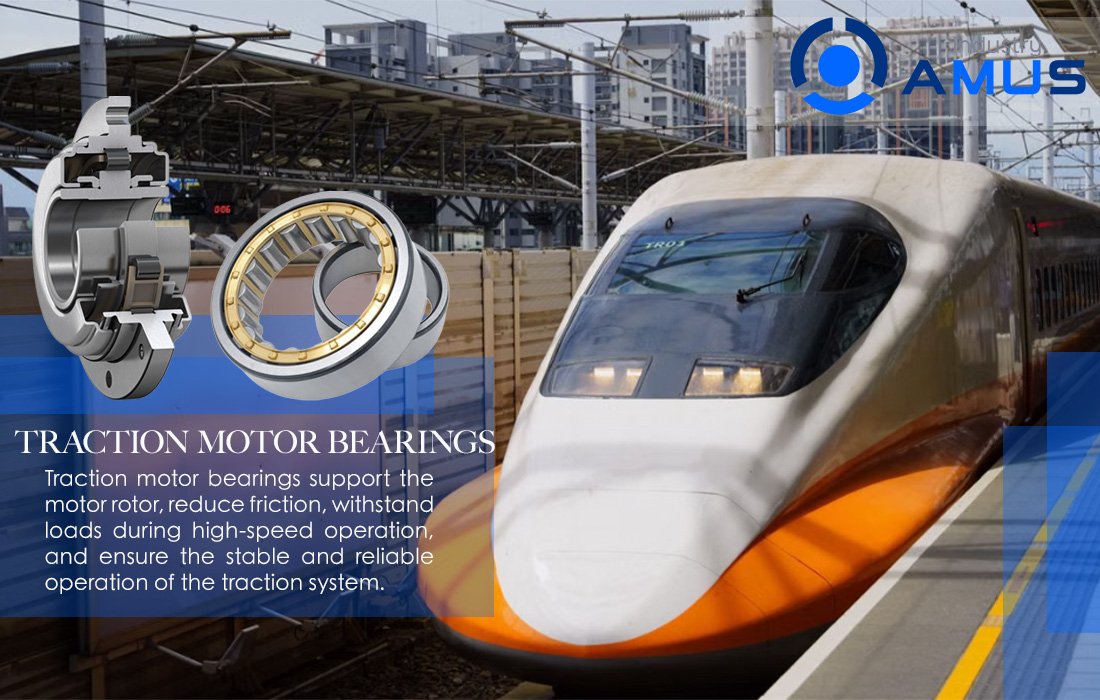
Cylindrical roller bearings are commonly used in railway traction motors. These bearings offer high radial load-bearing capacity and are suitable for high-speed rotation and heavy-load conditions.Deep-groove ball bearings are also suitable for certain traction motor designs. They feature low rotational friction and can accommodate both radial and axial loads.
Some electric railway vehicles utilize insulated bearings. Insulation structures mitigate the impact of shaft currents on the bearings, helping to reduce the risk of electrical erosion.Different traction motors require specific bearing configurations; the choice of bearing type depends on factors such as rotational speed, load, temperature, and available installation space.
Performance Requirements for Railway Traction Motor Bearings
High-speed performance is a crucial metric for traction motor bearings. As trains operate, traction motors often maintain high rotational speeds, requiring the bearings to ensure smooth, stable rotation.Load-bearing capacity is equally important. The motor rotor generates continuous operational loads, and bearings must also withstand dynamic load fluctuations during vehicle startup and acceleration.
Temperature control is also vital. High-speed rotation generates frictional heat; effective lubrication strategies reduce friction and help control the temperature rise within the bearings. Insulation performance is also a critical requirement for certain traction motor bearings. Shaft currents can cause electrical erosion; insulated bearings help reduce the flow of current through the rolling contact zones.
Sealing performance also impacts bearing operation. Effective seals minimize the ingress of dust and impurities into the bearing and help maintain the integrity of the lubricant.
Applications of Railway Traction Motor Bearings
Railway traction motor bearings are widely used in electric locomotives, electric multiple units (EMUs), metro vehicles, and urban rail transit vehicles.Different rail vehicles operate under varying speeds and conditions. High-speed EMUs prioritize high-speed rotational performance, whereas metro vehicles must withstand frequent starting and braking cycles.
Traction motor bearings must also accommodate various mounting configurations. Selection depends on factors such as shaft diameter, rotational speed, load, temperature, lubrication method, and insulation requirements.
Key Considerations for Selecting Railway Traction Motor Bearings
When selecting bearings for railway traction motors, the motor model and mounting dimensions must first be verified.Next, the radial and axial loads must be determined, and the operating speed is a crucial parameter.
Operating temperature affects lubrication and bearing service life, while the operating environment influences the choice of sealing configuration.
For electric drive systems, insulation requirements must also be addressed. An appropriate bearing design enhances the operational reliability of the traction motor.
Conclusion
Railway traction motor bearings perform essential functions such as rotor support, positioning, and friction reduction, directly influencing the motor’s operational performance.
As rail transit evolves toward higher speeds and greater reliability, traction motor bearings must offer superior high-speed performance, load-carrying capacity, insulation properties, and thermal stability.
Proper selection of bearing types and lubrication schemes ensures stable operation of railway traction motors and meets the specific needs of various rail transit vehicles