The core positioning of railway bearings: key components for ensuring safety and efficiency.
As a core component of the train’s running gear, railway bearings bear crucial functions such as supporting the weight of the car body, transmitting power, and buffering vibration and impact, directly affecting the train’s operational safety, speed, and comfort. Whether it’s a conventional train, a high-speed train, a freight train, or an urban rail transit vehicle, the wheelset axle system of its running gear relies on high-performance bearings for stable operation. The requirements for bearings in railway transportation are extremely stringent: they must withstand the instantaneous impact loads during train start-up and stopping, the continuous centrifugal force at high speeds, and adapt to a wide temperature range of -40℃ to 60℃, resisting the erosion of track dust, rainwater, ice, and snow. In high-speed trains, bearings must also meet the high-speed requirements of over 350 km/h and possess extremely low friction coefficients and vibration noise to ensure a comfortable passenger experience. Compared to ordinary industrial bearings, railway bearings must meet higher standards in terms of material strength, precision control, sealing performance, and reliability, making them one of the important indicators for measuring the manufacturing level of rail transit equipment.
Mainstream Application Scenarios and Technology Adaptation of Railway Bearings
1. High-Speed Trains: Ultimate Performance for Ultra-High-Speed Operation
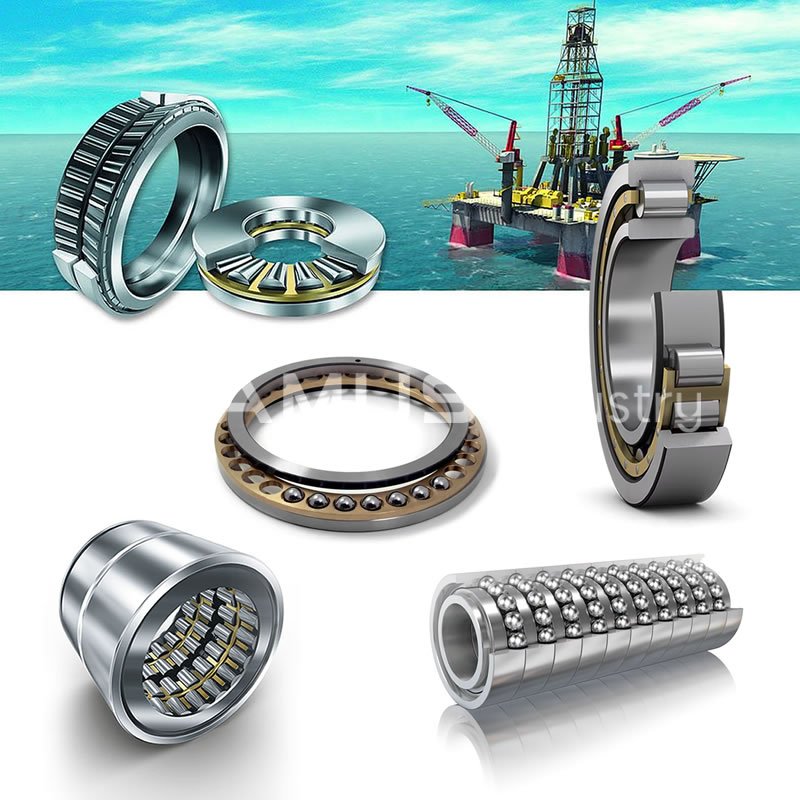
High-speed train bogie bearings are among the most technologically advanced railway bearings, requiring absolute reliability during ultra-high-speed, long-distance operation. These bearings typically employ a single-row tapered roller bearing or a double-row angular contact ball bearing structure. The outer and inner rings are made of high-strength carburized bearing steel, precision ground and ultra-precision machined to ensure micron-level dimensional accuracy. The rolling elements use ceramic or optimized alloy steel rollers, coupled with nano-grade grease, significantly reducing friction loss and heat generation, enabling long-term stable operation at speeds up to 350 km/h. To ensure safety, high-speed train bearings integrate temperature monitoring and vibration sensing systems, which can collect operational data in real time and transmit it to the train control system. In case of abnormal temperatures or excessive vibration, timely warning signals are issued, supporting predictive maintenance. Actual test data from a major high-speed train bearing shows a service life exceeding 800,000 kilometers, far exceeding the industry average, with a failure rate of less than 0.01%.
2. Freight Trains: Durability Guarantee Under Heavy Load Conditions
The core challenges faced by freight trains (especially heavy-haul railway trains) are heavy loads, frequent starts and stops, and harsh operating environments, placing extremely high demands on the load-bearing capacity and wear resistance of bearings. Freight train bearings primarily employ double-row tapered roller bearings. The outer ring is thickened to enhance structural strength, while the inner ring raceway features an optimized convexity design to distribute contact stress and prevent localized wear. The sealing structure utilizes a multi-labyrinth design, coupled with contamination-resistant grease, effectively preventing the intrusion of impurities such as coal dust, ore fragments, and rainwater, adapting to the open-air, dusty freight environment. In heavy-haul railways, bearings must withstand loads exceeding 30 tons per axle, with some ultra-heavy-haul trains even reaching 40 tons. Therefore, the bearing material requires special heat treatment to increase its hardness to HRC62 or higher, while also possessing good toughness to resist impact loads. A case study of heavy-haul railway applications shows that high-quality freight train bearings can achieve 600,000 kilometers of trouble-free operation, extending the maintenance cycle to 300,000 kilometers, which significantly reduces the maintenance costs and downtime for freight companies.
3. Urban Rail Transit: Adaptable to Frequent Starts and Stops and Complex Environments
Urban rail transit vehicles such as subways and light rail are characterized by short station intervals, frequent starts and stops, and complex operating environments (humid, dusty, and corrosive gases in tunnels). This places high demands on the flexibility, sealing performance, and low noise of bearings. Urban rail vehicle bearings primarily use deep groove ball bearings or cylindrical roller bearings, which have a compact structure and low rotational resistance, making them suitable for frequent start and stop conditions. The sealing system employs a dual sealing structure combining contact and non-contact methods, effectively blocking dust and moisture in tunnels while reducing operating noise and ensuring a comfortable urban environment. Furthermore, urban rail vehicle bearings must possess excellent corrosion resistance. To address the humid environment and slightly corrosive gases in tunnels, the outer ring surface of the bearing is treated with galvanization or an anti-corrosion coating to extend its service life. Simultaneously, its low-noise design can control operating noise below 60 decibels, meeting the environmental protection requirements of urban rail transit.
4. Conventional-Speed Trains: Balanced Performance Ensures Universal Applicability
Conventional-speed trains, as the foundation of railway transportation, cover various scenarios including trunk line passenger transport and regional freight transport. Bearings for these trains must balance reliability, economy, and ease of maintenance. These bearings mostly adopt a mature single-row tapered roller bearing structure, with stable manufacturing processes and controllable costs. They also possess good load-bearing capacity and self-aligning performance, suitable for the operating speed (120-160 km/h) and load requirements of conventional-speed trains. The sealing structure of conventional-speed train bearings is mainly contact-type sealing, coupled with long-life grease, allowing for a maintenance cycle of up to 300,000 kilometers, adapting to the maintenance conditions along railway lines. Some models also feature optimized installation structures, adopting a modular design for easy on-site disassembly and replacement, reducing maintenance difficulty.
Core Technology Requirements and Development Trends of Railway Bearings
1. Core Technical Requirements: A Dual Bottom Line for Safety and Performance
Materials and Processes: High-quality bearing steel (such as GCr15SiMn, carburized bearing steel) must be used. Processes such as vacuum degassing and electroslag remelting are employed to improve material purity, reduce impurities, and prevent fatigue cracking. Heat treatment processes must be precisely controlled to ensure a balance between bearing hardness, toughness, and dimensional stability.
Precision and Stability: Dimensional accuracy must meet or exceed ISO Class 3 standards, and rotational accuracy must reach P2 level to ensure concentricity and stability during high-speed operation. Bearing clearance must be strictly controlled to accommodate thermal expansion and contraction during train operation, preventing excessive or insufficient clearance that could cause vibration and overheating.
Sealing and Lubrication: The sealing structure must be customized according to the operating environment to achieve dustproof, waterproof, and corrosion-resistant properties. The lubricating grease must possess high-temperature stability, anti-wear properties, and long-lasting performance. Some high-end bearings utilize oil-air lubrication systems, with real-time replenishment of the lubricating medium to further extend their lifespan. Safety monitoring: Modern railway bearings generally integrate sensing technology to monitor parameters such as temperature, vibration, and speed in real time. Through big data analysis, they can achieve fault early warning and life prediction, shifting from passive maintenance to active protection.
2. Industry Development Trends: Intelligentization, Lightweight Design, and Long Lifespan
Intelligent Upgrade: With the improvement of the intelligence level of rail transit, bearings will further integrate more sensing functions, combining 5G and IoT technologies to achieve real-time data transmission and remote monitoring, and build a full life cycle management system. Some companies have already developed “intelligent bearing + AI diagnostic” systems, which can provide early warning of potential faults up to 72 hours in advance, significantly improving operational safety.
Lightweighting and Energy Saving: Under the “dual carbon” goal, railway bearings are developing towards lightweighting, adopting lightweight materials such as high-strength aluminum alloys and ceramics to reduce the weight of the bearings themselves and reduce train energy consumption; at the same time, optimizing the bearing structural design reduces the coefficient of friction and improves energy utilization efficiency.
Long Lifespan and High Reliability: Through material innovation (such as the use of third-generation bearing steel and ceramic composite materials), process upgrades (such as ultra-precision machining and laser strengthening), and breakthroughs in lubrication technology, the service life of bearings is further extended. The design life of some high-end products has exceeded 1 million kilometers, reducing the total life cycle cost.
Customized Adaptation: Customized bearing solutions are provided to meet the needs of different lines (high-speed, heavy-load, urban rail) and different environments (high-altitude, high-temperature, high-humidity), such as low-temperature resistant bearings for high-altitude areas and corrosion-resistant bearings for coastal areas, improving adaptability and reliability.
Key Points for the Application and Maintenance of Railway Bearings
1. Strict Selection for Suitable Scenarios
Selection must be based on train type (high-speed, freight, urban rail), operating parameters (speed, load, temperature), and track environment to clearly define the bearing type, size, precision grade, sealing structure, and lubrication method. For example, in high-speed scenarios, low-friction, high-precision angular contact ball bearings or tapered roller bearings are preferred, while in heavy-load scenarios, high-load double-row tapered roller bearings are selected.
2. Standardized Installation to Ensure Precision
During installation, the fit between the bearing and the shaft system and bogie must be ensured to avoid excessive or insufficient interference; bolt tightening torque must be uniform to prevent uneven stress; the mounting surface must be cleaned to avoid wear and vibration caused by residual impurities.
3. Scientific Maintenance to Extend Lifespan
Regularly check bearing temperature, vibration, and lubrication status, and replace grease according to the schedule; take protective measures for different environments, such as using low-temperature resistant grease in cold regions and strengthening sealing protection in coastal areas; promptly handle abnormal data and arrange maintenance according to early warning information to prevent the fault from escalating.