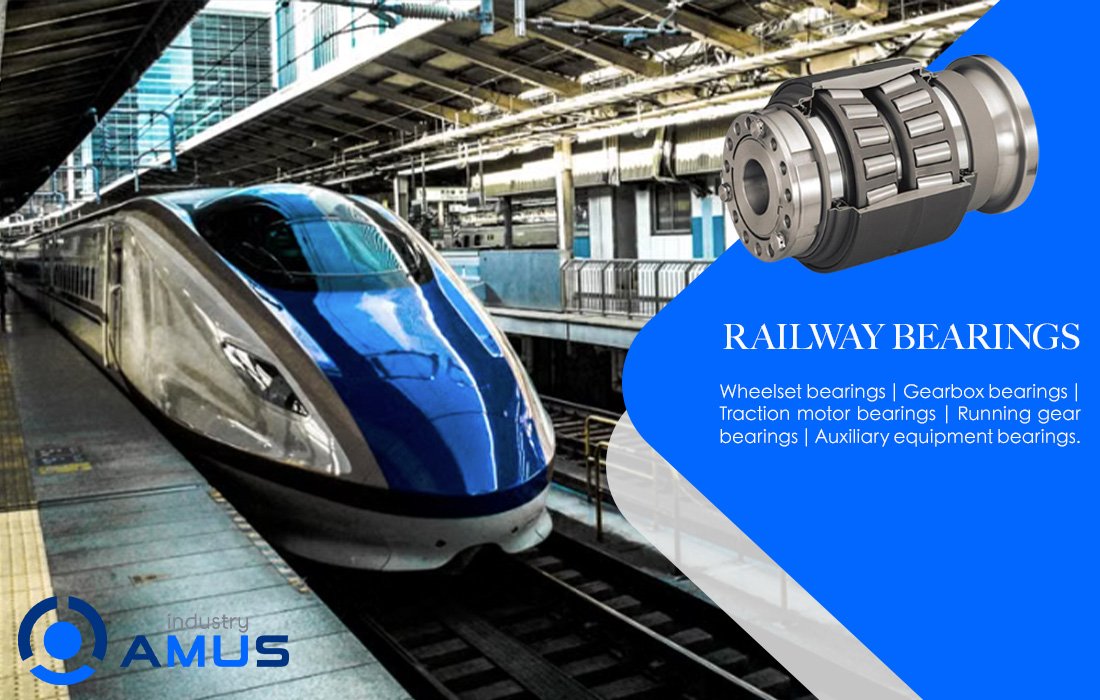
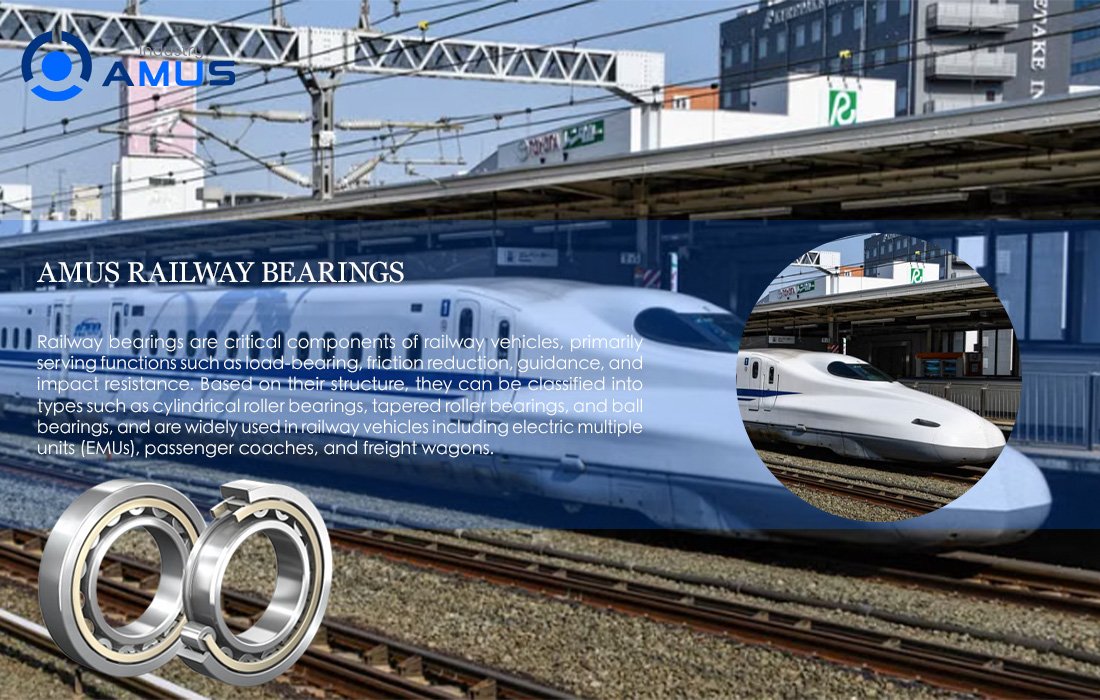
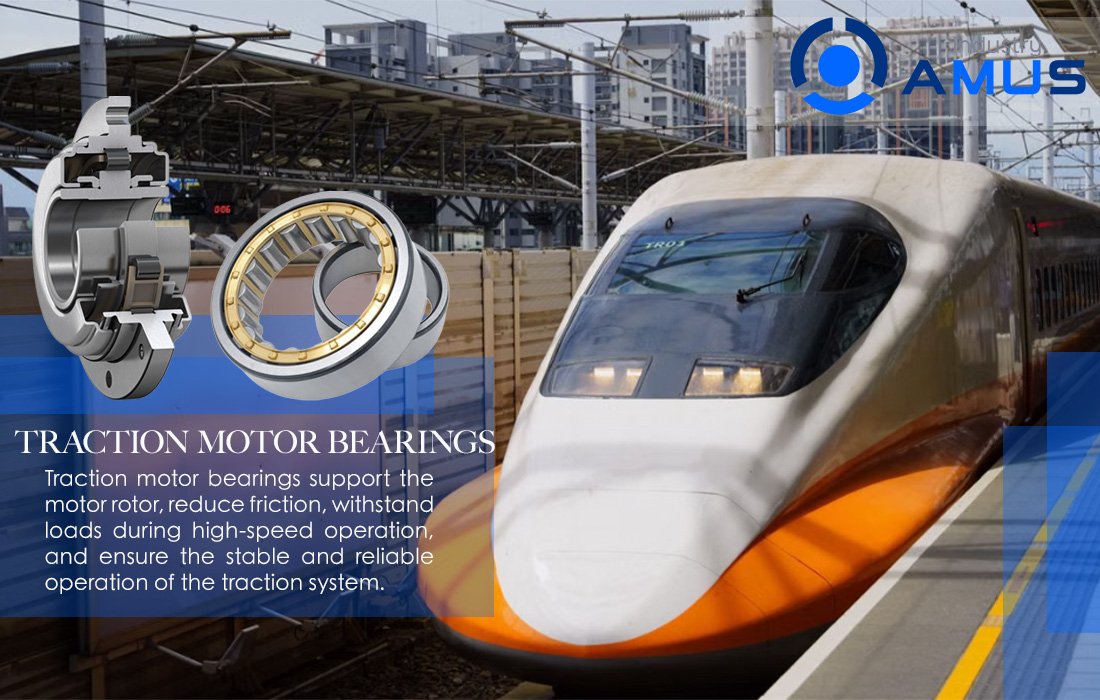
Railway bearings are critical mechanical components specifically used in railway vehicles and rail transit equipment, primarily installed in the wheelset systems of locomotives, passenger cars, freight cars, high-speed trains, and urban rail vehicles. They play a vital role in supporting the wheels and axles, transmitting loads, and reducing friction, making them one of the core components ensuring the safe, stable, and efficient operation of trains.
Railway bearings are subjected to high-speed rotation, heavy-load impacts, vibrations, and complex environmental conditions during long-term train operation, thus placing higher demands on their precision, strength, wear resistance, and reliability.
Structure of Railway Bearings
Railway bearings mainly consist of an inner ring, outer ring, rolling elements, cage, sealing components, and a lubrication system.The inner ring is a crucial rotating component of the railway bearing, typically installed at the axle journal and rotating with the axle. The inner ring primarily bears the load transmission from the axle and requires high dimensional accuracy and wear resistance. A high-quality inner ring reduces frictional losses during operation, extending the overall service life of the bearing.
The outer ring is the supporting component of the railway bearing, usually installed inside the axle box of the vehicle. The outer ring provides a stable running track for the rolling elements and bears external loads transmitted from the vehicle structure. In high-speed operating environments, the outer ring needs to maintain high strength and stability to ensure continuous and reliable bearing operation.
The rolling elements are the core components of railway bearings, responsible for transmitting loads and reducing friction. Common railway bearings use cylindrical rollers or tapered rollers. The rolling elements roll between the inner and outer rings, converting sliding friction into rolling friction, thereby reducing energy loss and improving operating efficiency.
The cage is mainly used to control the position of the rolling elements, keeping them evenly aligned. It prevents collisions between the rolling elements, improves lubrication, and reduces noise and vibration during bearing operation. Railway bearings typically use high-strength cages to meet the requirements of long-term high-speed operation.
The sealing assembly is an important part of protecting the internal structure of the railway bearing. It prevents dust, moisture, and other impurities from entering the bearing, while also preventing the loss of lubricating media. Good sealing performance reduces bearing wear and improves the reliability and service life of railway bearings.
The lubrication system is mainly used to reduce internal bearing friction and reduce operating temperature rise. Railway bearings are typically lubricated with specialized grease or oil. Proper lubrication reduces wear on components and maintains the bearing in good operating condition.
When a railway bearing is in operation, the wheels drive the axle to rotate, which in turn drives the inner ring of the bearing. The rolling elements roll between the inner and outer rings, transmitting the load generated by the vehicle to the axle box structure. Through the coordinated work of various components, the railway bearing achieves functions such as load bearing, friction reduction, and stable operation.
Types of Railway Bearings
Cylindrical roller bearings are a commonly used type of bearing in railway vehicles. They use cylindrical rollers as rolling elements, possessing a large radial load-bearing capacity and high running accuracy. This type of bearing has low frictional resistance, stable operation, and is suitable for railway passenger cars, freight cars, and some rail vehicles, meeting the requirements of long-term continuous operation.
Tapered roller bearings use a tapered roller structure and can simultaneously bear radial and axial loads. They have strong impact resistance and comprehensive load-bearing performance, making them suitable for heavy-duty railway vehicles, freight trains, and equipment operating in complex environments. This type of bearing effectively improves vehicle operational reliability and extends service life.
Railway wheelset bearing units are integrated bearing structures that combine bearings, sealing devices, and lubrication systems. They offer advantages such as compact structure, easy installation, good sealing performance, and long maintenance cycles. Currently, this type of bearing is widely used in high-speed trains, subway vehicles, and modern rail transit equipment.
High-speed railway bearings are mainly used in high-speed trains and high-speed trains. Due to the high operating speeds, these bearings need to possess characteristics such as high precision, low temperature rise, low noise, and long service life to ensure stable operation of the vehicle at high speeds.
Heavy-duty railway bearings are mainly used in freight railway systems, needing to withstand significant vehicle weight and impact loads. They feature high load-bearing capacity, high wear resistance, and good fatigue resistance, making them suitable for heavy-duty railway transportation fields such as ore and coal transport.
Railway Bearing Types and Size Ranges
1. Railway Cylindrical Roller Bearing
Railway cylindrical roller bearings are one of the most commonly used bearing types in railway vehicles, mainly used in passenger cars, freight cars, and some rail vehicles.
Common Models:
- NU Series Cylindrical Roller Bearings
- NJ Series Cylindrical Roller Bearings
- NUP Series Cylindrical Roller Bearings
Common Model Examples:
- NU320 Series
- NU330 Series
- NU1030 Series
Size Range:
- Inner Diameter Range: Approx. 50mm~250mm
- Outer Diameter Range: Approx. 90mm~420mm
- Width Range: Approx. 30mm~120mm
Features: Cylindrical roller bearings have high radial load capacity, low running resistance, and are suitable for high-speed rotation environments.
2. Railway Tapered Roller Bearings
Tapered roller bearings can simultaneously withstand radial and axial loads and are commonly used in railway freight cars and heavy-duty vehicles.
Common Models:
- 302 Series
- 303 Series
- 313 Series
Features: This type of bearing has high load-bearing capacity and good impact resistance, suitable for heavy-haul railway transportation environments.
3. Railway Wheelset Bearing Units
Railway bearing units are integrated products that combine bearings, sealing devices, and lubrication systems.
Common Applications:
- High-speed trains
- Urban subway vehicles
- Passenger trains
Common Models:
- TAROL series railway bearing units
- TBU series railway bearing units
Size Range:
- Inner diameter range: approx. 100mm~180mm
- Outer diameter range: approx. 180mm~320mm
- Width range: approx. 100mm~180mm
Features: Compact structure, easy installation, excellent sealing performance, and long maintenance cycle.
4. High-speed Railway Bearings
High-speed railway bearings are mainly used in high-speed trains and EMUs, requiring high precision and performance.
Common Models:
- High-speed train bearings
- Train wheelset bearings
High-speed cylindrical roller bearings
Size Range:
- Outer diameter range: approx. 220mm~400mm
- Width range: approx. 80mm~160mm
Features: High-speed operation, low temperature rise, low noise, and high reliability.
5. Heavy-duty railway bearings
Heavy-duty railway bearings are mainly used in freight trains, mining railway transport vehicles, and other equipment.
Common Models:
- Axle box bearings
- Double row tapered roller bearings
- Heavy-duty wheelset bearings
Size Range:
- Inner diameter range: approx. 120mm~300mm
- Outer diameter range: approx. 250mm~500mm
- Width range: approx. 150mm~250mm
Features: High load capacity, strong impact resistance, and long service life.
Conclusion
Railway bearings are key components in rail transit systems, primarily responsible for supporting axles, reducing friction, and transmitting loads. Although small in size, they directly impact train operation safety, stability, and transportation efficiency.
High-quality railway bearings utilize superior materials and precision manufacturing processes, offering advantages such as high load-bearing capacity, wear resistance, fatigue resistance, and long service life. They can withstand complex operating conditions including high speed, heavy loads, and long-term operation. Reliable railway bearings can reduce equipment failure rates, decrease maintenance costs, and improve railway transportation efficiency.
With the development of high-speed railways and intelligent rail transit, railway bearings are continuously upgrading towards higher precision and reliability. High-quality railway bearings not only ensure safe train operation but also create greater economic and social value for modern railway transportation.