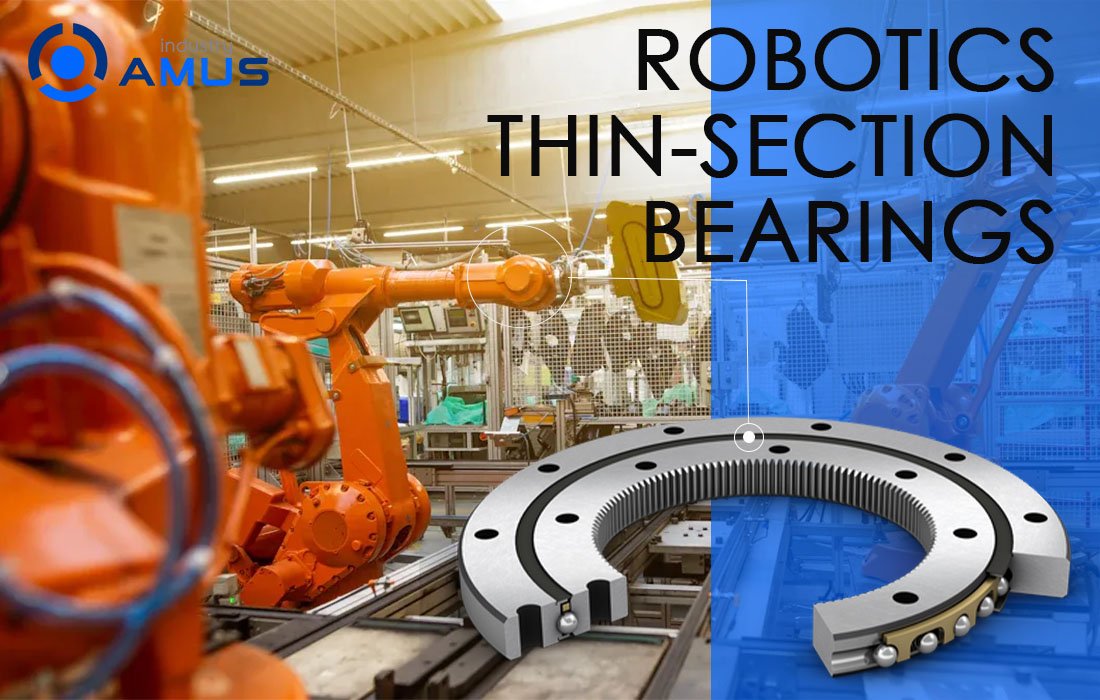
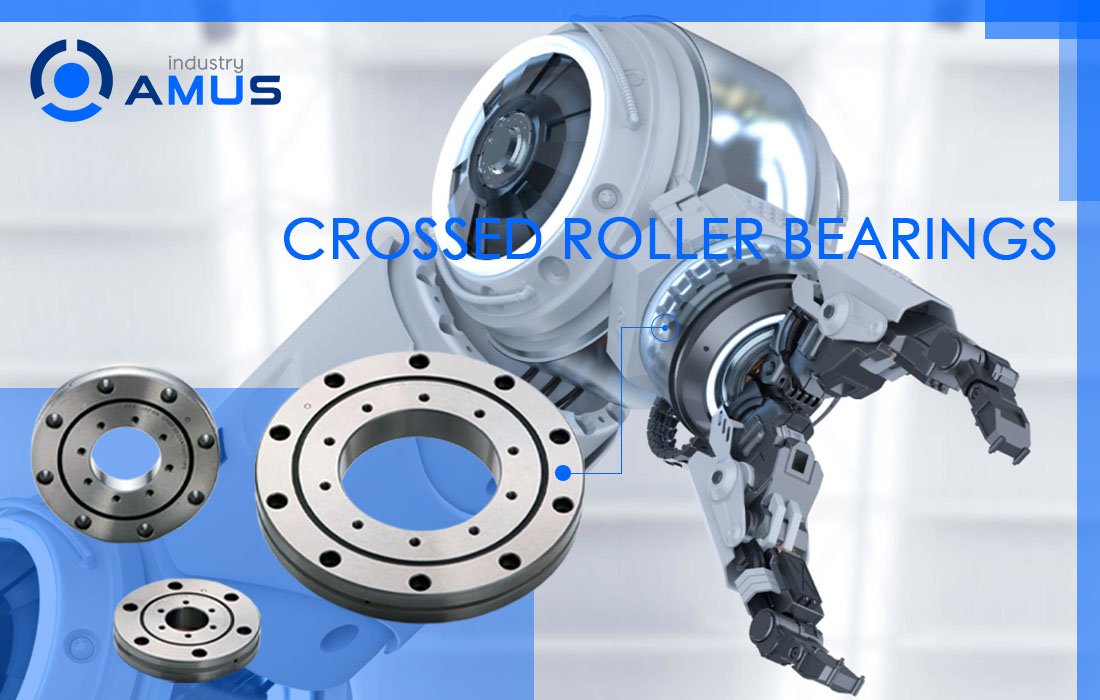
Crossed roller bearings are critical components in the precision joints of industrial robots. As automation technology advances, robots increasingly demand higher rotational accuracy, load-bearing capacity, and structural compactness. Thanks to their unique roller arrangement, crossed roller bearings provide stable rotational support for robotic arms and enable precise joint movement.
I. What is a crossed roller bearing for robotic arms?
Crossed roller bearings feature a design where cylindrical rollers are arranged in a crisscross pattern, typically with adjacent rollers positioned at a 90-degree angle to one another. This configuration allows them to simultaneously withstand radial loads, axial loads, and overturning moments. Consequently, a single bearing can meet the multi-directional support requirements of a robotic arm.
Compared to standard rolling bearings, crossed roller bearings offer superior rigidity and rotational accuracy. Furthermore, their compact structure helps minimize the installation space required for joint modules, opening up new possibilities for lightweight robot designs.
II. Applications of crossed roller bearings in robotic arms
Robotic arms typically perform tasks such as rotation, gripping, handling, and precision positioning. Since different joints bear varying loads, the performance requirements for the bearings differ accordingly.
First, shoulder and elbow joints must withstand the weight of the robotic arm itself as well as the overturning moments generated by the payload at the end-effector. Crossed roller bearings provide stable support, helping these joints maintain high structural rigidity.
Second, wrist joints often have limited installation space. Compact crossed roller bearings fit within these confined spaces while enabling the robotic arm to execute flexible rotational movements.
Additionally, robot bases and precision rotary platforms utilize crossed roller bearings to meet requirements for continuous rotation, angular positioning, and multi-directional load support.
III. Key advantages of crossed roller bearings for robotic arms
1. High-rigidity support
Crossed roller bearings can withstand loads from multiple directions simultaneously and effectively resist overturning moments. Their optimized structural design and preload settings minimize elastic deformation under load, thereby enhancing the motion stability of the robotic arm. 2. High Rotational Accuracy
Precision machining, proper fits, and appropriate preload help minimize operational errors in the bearings. These characteristics enable robotic arms to achieve higher positioning accuracy, meeting the demands of applications such as precision assembly, inspection, and automated machining.
3. Space-Saving Installation
Crossed roller bearings integrate the capacity to support loads from multiple directions, simplifying bearing arrangements in certain rotary mechanisms. This allows designers to optimize the internal structure of the joint and make efficient use of limited installation space.
4. Suitability for Complex Motion
Robotic arm joints frequently undergo start-stop cycles, reversals, and speed changes. Selecting the right bearing structure, lubrication method, and preload parameters improves operational performance and ensures long-term, stable equipment operation.
IV. How to Select the Right Crossed Roller Bearing for Robotic Arms?
When selecting a bearing, first determine the joint’s installation dimensions, including inner diameter, outer diameter, width, and mounting hole locations. Accurate dimensional data narrows down the selection options and helps designers verify the available assembly space.
Next, evaluate radial loads, axial loads, and overturning moments. For robots with long reaches, the end-effector load and the length of the moment arm significantly impact joint torque; therefore, selection should not rely solely on the bearing’s rated load capacity.
Designers must also consider rotational speed, positioning accuracy, service life, and the operating environment. High-precision applications require attention to bearing accuracy grades, preload methods, and the machining quality of mounting surfaces, while high-frequency operation scenarios necessitate a focus on lubrication, sealing, and temperature rise control.
Finally, the mounting structure is crucial. Uniform bolt tightening force, good mounting surface flatness, and a well-designed fit all contribute to maximizing the performance of crossed roller bearings.
V. Recommendations for Maintenance and Use
Routine maintenance helps maintain the robotic arm’s stable operation. Operators should regularly check for rotational resistance, abnormal noise, temperature rise, and lubrication status, addressing any irregularities promptly.
Additionally, installation personnel must control assembly precision and bolt tightening force according to design specifications to prevent installation-induced deformation from affecting bearing performance. For robotic arms subject to frequent start-stop cycles or shock loads, inspection plans should be tailored to actual operating conditions.
VI. Conclusion
Thanks to their high rigidity, high precision, and compact design, crossed roller bearings for robotic arms play a vital role in industrial robots, collaborative robots, and precision rotary mechanisms. Properly selecting the bearing series, load parameters, and mounting method enhances the operational stability of robot joints and provides reliable rotational support for precision automation applications.