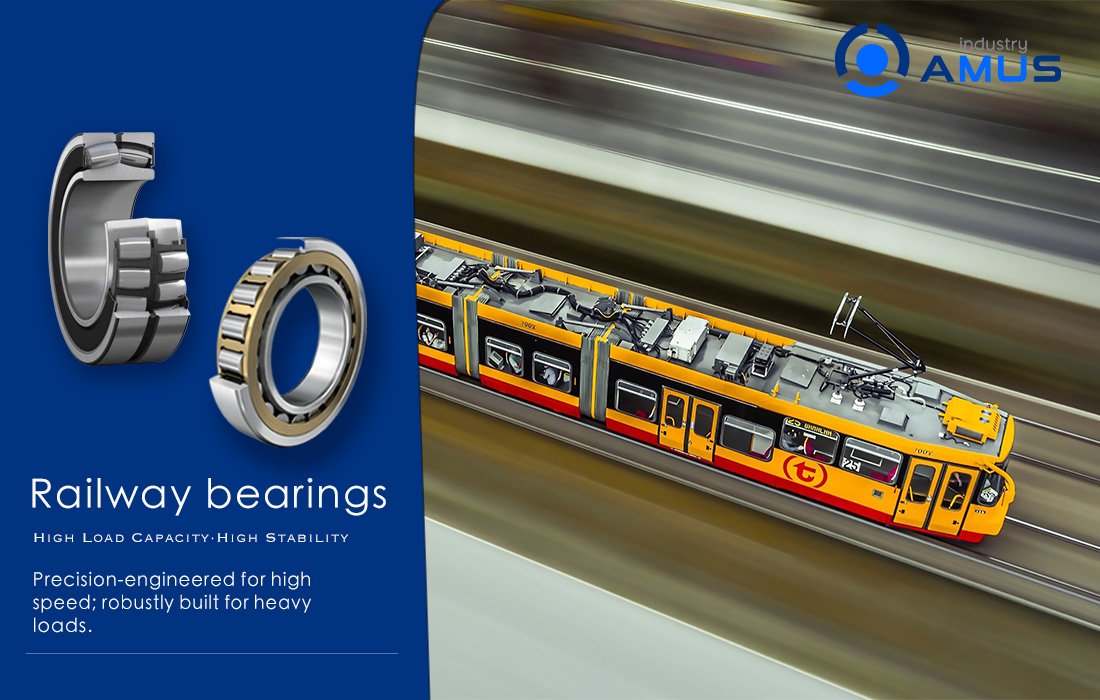
Railway vehicles encounter diverse operating environments daily. Starting, braking, accelerating, and decelerating generate load fluctuations. Track joints, track irregularities, and vehicle vibrations also induce transient impacts. Consequently, railway bearings must possess excellent impact resistance.
Why Impact Resistance Matters for Railway Bearings
During train operation, continuous loads are generated between the wheel and the rail. Bearings are subjected to additional impacts when encountering track irregularities.
Freight trains must also withstand heavy vehicle loads. Significant dynamic loads are exerted on the bearings during starting and braking.
Superior impact resistance ensures stable bearing operation. Bearings must withstand rapid load fluctuations while maintaining smooth rotation.
High Load-Carrying Capacity to Handle Transient Loads
Railway bearings must withstand both radial and axial loads. The direction and magnitude of these loads vary depending on operating conditions.
High load-carrying capacity enhances the bearing’s ability to withstand impact loads. Stable rolling contact minimizes abnormal friction and localized damage.
Railway freight cars, locomotives, and other rolling stock have distinct load requirements. Bearings must be matched to the vehicle structure and operating conditions to provide appropriate load-carrying performance.
Structural Stability and Impact Resistance
Bearing structure directly influences operational stability. The raceways, rolling elements, and cages must maintain precise alignment and fit.
An optimized internal structure minimizes abnormal movement during impacts. Stable component interaction ensures rolling elements maintain their proper operating paths.
Railway bearings must also maintain appropriate internal clearance. Excessive clearance can increase vibration, while insufficient clearance may lead to increased friction and temperature rise.
Managing Vibration in Railway Operations
Railway vehicles generate continuous vibration during operation. Varying track conditions result in differing levels of vibration and impact.
Railway bearings must maintain stable rotation. Excellent vibration resistance reduces operating noise and minimizes abnormal vibration.
Impact and vibration are critical concerns in high-speed operations. Bearings must balance high-speed performance, load-carrying capacity, and impact resistance.
Adapting to Complex Railway Operating Conditions
Railway bearings are widely used in high-speed trains, electric multiple units (EMUs), passenger coaches, freight cars, and locomotives.
Different vehicles exhibit distinct operating characteristics. High-speed trains prioritize high-speed rotation and operational stability, whereas railway freight wagons focus more on heavy loads and impact loads.
For complex operating conditions, key considerations include bearing load-bearing capacity, impact resistance, wear resistance, and fatigue life.
Excellent impact resistance enables bearings to withstand operational stresses such as vehicle starting, braking, cornering, and track irregularities. Stable operational performance also enhances the reliability of the wheel-axle system.
Impact Resistance and Long-Term Operation
Railway bearings must withstand not only instantaneous impacts but also long-term, repetitive loading.
Frequent impacts can increase the risk of fatigue in raceways and rolling elements. Stable material properties and sound structural design help bearings maintain reliable performance over the long term.
Impact resistance is particularly critical for heavy-haul railways and long-distance transport, where bearings must maintain stable rotation under continuous loads and cyclic impacts.
The impact resistance of railway bearings is closely linked to their load-bearing capacity, fatigue resistance, and wear resistance. The synergy of these performance characteristics enhances operational stability in complex railway environments.