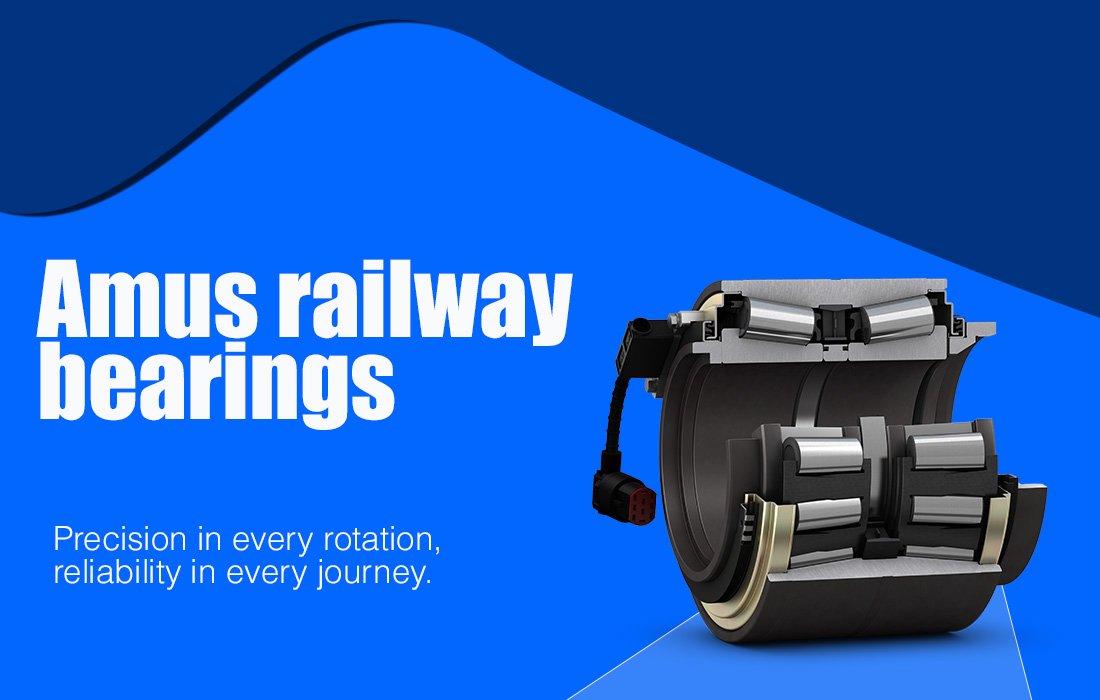
The precision of railway bearings directly affects operational stability, vibration levels, and service life. When purchasing or replacing railway bearings, users often encounter precision codes such as P0, P6, and P5. Understanding these codes allows for a more accurate assessment of a bearing’s manufacturing precision and its suitability for specific applications.
I. What are railway bearing precision codes?
Railway bearing precision codes indicate the dimensional and rotational precision of the bearing. Common codes include P0, P6, P5, P4, and P2.
Different precision classes correspond to varying dimensional tolerances and rotational precision standards. Generally, a higher code class signifies stricter precision requirements.
Common precision classes can be summarized as follows:
P0: Standard precision class; suitable for general railway bearing applications.
P6: Higher precision than P0; suitable for applications requiring greater operational stability.
P5: Higher dimensional and rotational precision; suitable for high-speed equipment.
P4: High precision class; typically used in high-speed and high-precision operating conditions.
P2: Very high precision class; primarily used for specialized applications requiring strict operational precision.
When selecting a bearing, one should not rely solely on the precision class; factors such as rotational speed, load, temperature, and installation conditions must also be considered.
II. How do you identify the precision code in a bearing model number?
Railway bearing model numbers are typically composed of multiple codes. These codes represent various specifications, such as bearing structure, dimensions, sealing type, internal clearance, and precision class.Taking a common model designation as an example, codes like P6 or P5 may appear at the end of the model number.A “P6” code indicates that the bearing meets the P6 precision class.A “P5” code signifies a higher level of precision.
Note that code meanings may vary across different standards and product systems. Therefore, when examining a specific bearing model, it is essential to consult the corresponding product catalog or technical standards.
III. Why do railway bearings require precision classes?
Railway vehicles operate under complex conditions for extended periods. Components such as wheels, wheelsets, and axle boxes are subjected to continuous radial and axial loads.
Insufficient bearing precision can lead to increased vibration and noise during operation—effects that become more pronounced at high speeds.An appropriate precision class helps ensure the bearing maintains stable rotation. At the same time, it helps improve operational stability.
However, higher precision is not always better. Excessive precision can increase costs and may not be suitable for all types of railway rolling stock.
IV. How to Select Railway Bearing Precision?
When selecting railway bearings, consider the following four aspects:
First, consider operating speed.
High-speed trains and electric multiple units (EMUs) demand higher bearing operational precision. High-speed operating conditions typically require stricter precision control.
Second, consider load conditions.
Freight cars and heavy-haul trains are subjected to significant loads. Selection requires attention to both the bearing structure and load-carrying capacity.
Third, consider operating temperature.
Bearings generate heat during prolonged operation. Temperature fluctuations can affect bearing fits and internal clearances.
Fourth, consider installation conditions.
The machining precision of the shaft and bearing housing is equally important. Proper installation fits help maintain stable bearing operation.
Therefore, the precision code for a railway bearing must be determined based on specific operating conditions; selection should not be based solely on P0, P6, or P5 ratings.
V. Summary of Common Railway Bearing Precision Codes
Railway bearing precision codes are primarily used to distinguish between different precision classes. P0 is a common basic class, while P6, P5, P4, and P2 correspond to increasingly higher precision requirements.
Requirements for bearings vary depending on the specific location and application within passenger cars, freight cars, locomotives, and EMUs.
To verify the precision class of a specific railway bearing, check the suffix code in the model number and consult the relevant technical documentation. This allows for a more accurate understanding of the bearing’s precision, structure, and scope of application.